Union apprenticeship programs have always represented the gold standard for trades education. The combination of classroom instruction and hands-on training produces skilled workers who can handle complex projects safely and efficiently. But today's apprentices will spend the next 30 to 40 years in an industry being transformed by artificial intelligence.
If apprenticeship programs don't adapt their curriculum to include AI education, they're sending graduates into a workplace they're not fully prepared to navigate.
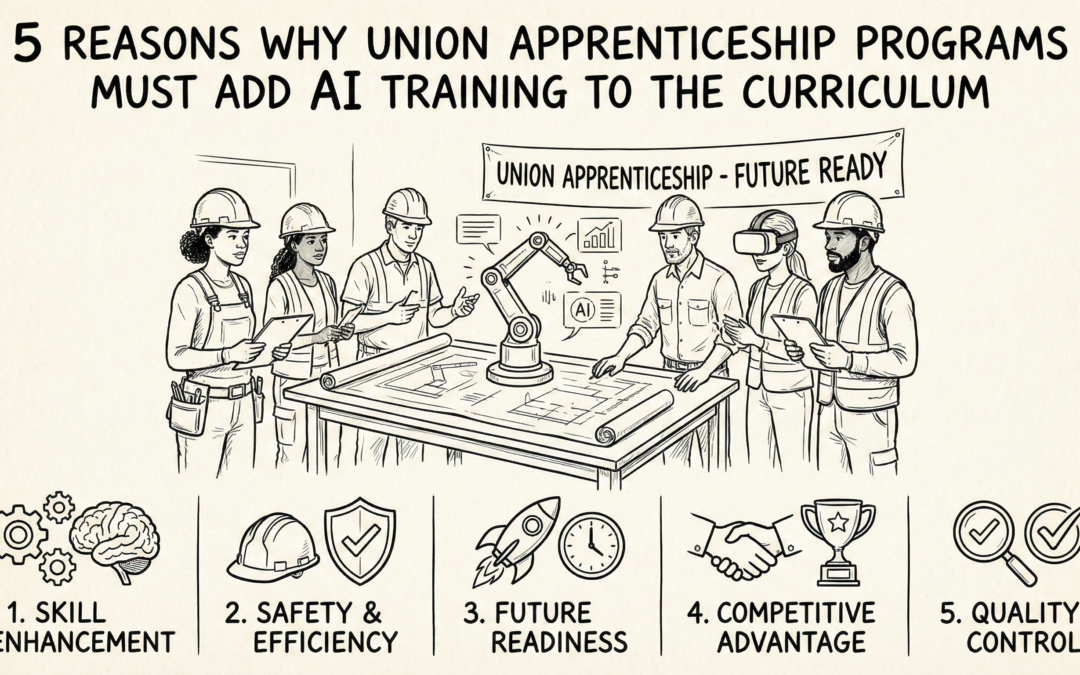
1. Apprentices Are Already Using AI Without Proper Training
Here's what program directors need to understand: your apprentices are already using ChatGPT and other AI tools. They're using them to study for tests, research unfamiliar terms, and figure out complex concepts. They're doing this without guidance on accuracy, appropriate use, or industry-specific applications.
A 2024 Pew Research study found that 59% of Americans aged 18-29 have used ChatGPT or similar AI tools. Your apprentices fall squarely in this demographic. The question isn't whether they'll use AI. It's whether they'll use it effectively and responsibly.
Without formal training, apprentices learn AI use through trial and error. They don't know how to verify information. They don't understand the limitations. They don't recognize when AI produces plausible-sounding but incorrect answers about electrical codes or structural requirements.
Formal AI education in the apprenticeship curriculum turns scattered experimentation into structured competency. It teaches critical evaluation alongside practical application. It prepares apprentices to use these tools as professional tradeworkers, not casual consumers.
2. AI Skills Actually Improve Traditional Trade Skills
Some skeptics worry that AI training takes valuable time away from core trade skills. The opposite is actually true. AI can accelerate and deepen learning of traditional skills when integrated properly.
Consider an electrical apprentice learning conduit bending. They can photograph their work, ask AI to analyze whether the bend meets code requirements, and get immediate feedback. A plumbing apprentice studying fixture installation can use AI to quiz them on proper specifications and installation sequences. An HVAC apprentice can input building parameters and have AI walk them through load calculation logic.
AI becomes a 24/7 study partner that never gets impatient with repeated questions. It supplements instructor-led training by providing additional practice and explanation between class sessions.
The same applies to blueprint reading, code interpretation, and project planning. AI tools can generate practice scenarios, provide instant feedback, and help apprentices understand complex concepts from multiple angles. The result is deeper learning of fundamental skills, not distraction from them.
3. Future Job Sites Will Require AI Competency
The construction sites where today's apprentices will work as journeyworkers and foremen will look different than current job sites. AI-powered project management software will handle scheduling. AI tools will assist with quality control inspections. Automated systems will track materials and productivity.
Workers who understand how to interact with these systems, verify their outputs, and use them effectively will advance faster in their careers. Those who don't will find themselves at a disadvantage.
General contractors are already implementing AI tools for project planning, cost tracking, and safety monitoring. They expect their trade partners to work effectively within these systems. An apprentice who graduates with AI competency can step onto these sites and immediately contribute at a higher level than one who has to learn these skills on the job.
Union contractors want workers who can handle tomorrow's projects, not just today's. Apprenticeship programs that produce AI-literate graduates give those contractors exactly what they need.
4. AI Training Accelerates Career Advancement
Most skilled tradeworkers don't stay in the tools their entire career. They become foremen, superintendents, project managers, estimators, and business owners. These advancement opportunities all require strong administrative and communication skills.
AI training directly supports this career progression. A journeyworker who can efficiently draft reports, create safety documentation, analyze project data, and communicate clearly with clients has a faster path to leadership roles.
Consider the foreman role. Modern foremen spend significant time on paperwork: daily reports, safety logs, material requisitions, change order documentation, and communication with the general contractor. AI can reduce this administrative burden from hours to minutes, letting foremen focus on leading their crews and managing work quality.
Apprentices who learn to use AI for administrative tasks while still in training arrive at the job site with skills that usually take years to develop. They're better positioned for advancement because they can handle both the technical trade work and the communication requirements of leadership.
5. The Competitive Advantage Is at Risk
Union apprenticeship programs have maintained their reputation because they stay current. When the industry shifted to digital plan reading, apprenticeships taught it. When new safety regulations emerged, programs incorporated them. When building codes changed, curriculum updated accordingly.
AI represents a shift of similar magnitude, but it's happening faster. Right now, non-union competitors and open shop programs are beginning to incorporate AI training. Some are marketing it as a differentiator to attract younger workers who expect modern technology training.
The apprenticeship system's competitive advantage has always been superior training. Letting others lead on AI education puts that advantage at risk. The programs that integrate AI training first will attract the best candidates and produce the most capable graduates.
Early adoption creates opportunity. The programs that integrate AI training now can refine their approach, develop best practices, and establish themselves as innovators. They'll attract apprentices who want cutting-edge training. They'll produce graduates that contractors specifically request.
Programs that wait will eventually be forced to add AI training just to keep pace. But they'll be playing catch-up, implementing someone else's model rather than defining their own.
Moving Forward
The ultimate purpose of apprenticeship programs is preparing people for long, successful careers in the skilled trades. That means looking beyond immediate job requirements to what workers will need over decades.
An apprentice who starts today might work until 2065 or beyond. The construction industry in 2065 will use technologies we can barely imagine today. But it will almost certainly use AI extensively, probably in ways far more sophisticated than current applications.
Union apprenticeships have always represented the best possible preparation for careers in the skilled trades. Adding AI education maintains that standard for a new generation. The programs that act now will define what quality AI training looks like in the construction trades.
The future of the skilled trades will be built by workers who combine traditional craft expertise with modern technological capability. Your apprenticeship program can make sure union workers lead that future.