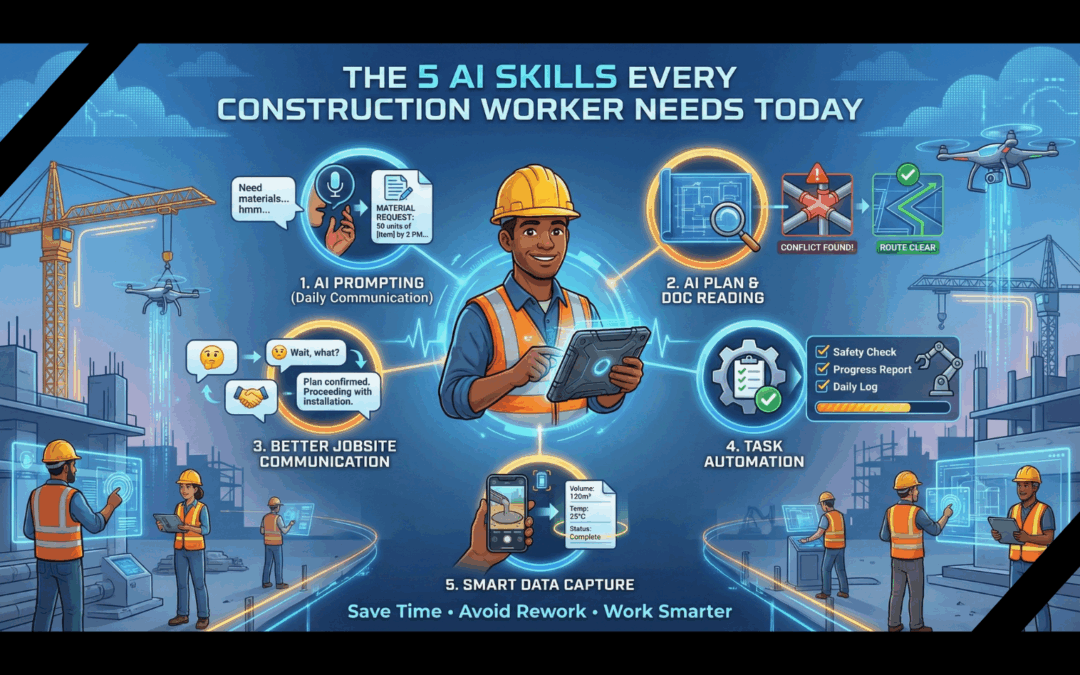
Construction work is changing. AI tools are moving from the office trailer to the job site, and workers who learn these five skills will have a major advantage. You don’t need to become a tech expert. You just need to know enough to save time, avoid rework, and make your day easier.
Why Construction Workers Need AI Skills Now
The construction industry loses billions each year to rework, miscommunication, and documentation problems. Workers spend hours on paperwork that could take minutes. Simple mistakes in reading plans cost thousands in materials and labor. These problems have existed forever, but now we have practical solutions that any tradesperson can learn.
Think about your typical day. How much time do you spend writing reports? Reading through thick specification books? Trying to explain a problem to the office? These are exactly the areas where AI helps most. Learning these skills isn’t about replacing your craft knowledge. It’s about getting the annoying stuff out of the way so you can focus on building.
Skill 1: AI Prompting for Daily Communication
Prompting is simply telling AI what you need in clear language. It’s like giving instructions to a new apprentice. The clearer you are, the better results you get.
The basic formula is simple: Role + Task + Details + Format. For example: “Act as a site foreman. Write a formal incident report for a minor injury that occurred today at 10:00 AM. A carpenter tripped over an extension cord in the main hallway and twisted their ankle. First aid was applied immediately. Include corrective actions we’re taking.”
This skill matters because it turns a 30-minute writing task into a 2-minute review task. Site supervisors using AI for reports save an average of 5 hours per week according to recent Procore usage data. That’s time you can spend actually managing the site instead of staring at a blank screen.
Start practicing with simple tasks. Draft your next delay notice. Create tomorrow’s safety briefing. Write that awkward email to the architect. The more you practice, the faster you’ll get the exact output you need.
Skill 2: AI-Powered Plan and Document Reading
Modern AI tools can read construction documents and instantly find what matters to you. Instead of flipping through 200 pages of specs, you can ask AI to find every mention of your scope of work. Tools like Autodesk Construction Cloud now flag conflicts before you start building, showing you where that new duct will hit an existing beam.
This prevents the nightmare scenario every tradesperson knows: discovering a conflict after you’ve already installed your work. The Dodge Data Analytics 2023 report found that 52% of rework comes from coordination issues that could have been caught earlier. AI catches these problems while they’re still just pixels on a screen, not installed materials you need to tear out.
To use this skill, you need to know how to navigate digital models on a tablet and understand what AI flags mean. When the system highlights a “high risk clash” in red, you know to check with the super before proceeding. It’s not complicated, but it does require paying attention to the warnings instead of dismissing them.
Skill 3: Better Jobsite Communication
Bad communication causes more problems on job sites than almost anything else. AI helps you write clearly without sounding like a robot or a lawyer. You can take your rough notes and turn them into professional communication that gets your point across without creating confusion or conflict.
For instance, you might type: “The electrical guy messed up and now we can’t finish.” AI can help you rewrite it as: “We encountered an unexpected electrical routing that conflicts with our installation. We need to coordinate with the electrical contractor before proceeding to avoid rework.”
According to FMI’s 2023 research, poor communication costs the average construction project 5% of its total value. That’s real money lost to misunderstandings, unclear instructions, and messages that never get sent because writing them feels too hard. AI removes that friction.
The key is maintaining your voice while improving clarity. You’re not trying to sound fancy. You’re trying to be understood the first time, every time.
Skill 4: Task Automation for Repetitive Work
Every trade has tasks they do over and over. Daily safety briefings. Material takeoffs. Progress reports. Quality checklists. AI can automate these without losing quality. In fact, automation often improves consistency because the AI never forgets a step.
You can create templates for common tasks and let AI fill in the specifics. Set up a custom GPT that knows your company’s safety protocols. Build a workflow that turns field photos into punch lists. Create triggers that automatically generate required documentation at the right times.
A mechanical contractor in Denver started using AI to generate daily Job Hazard Analyses. What used to take their foremen 20 minutes each morning now takes 3 minutes of review. Over a year, that saved 68 hours per foreman. That’s nearly two full work weeks of time recovered.
The skill here isn’t programming. It’s recognizing which tasks eat your time and setting up simple automations to handle them. Most AI tools now offer templates you can customize without any coding knowledge.
Skill 5: Smart Data Capture and Documentation
The biggest change AI brings is turning field observations into finished documentation without typing. You can talk to your phone for 30 seconds and get a complete site report. Take a photo of installed work and automatically generate as-built documentation. Record a voice note about a problem and receive a formatted RFI.
This matters because accurate documentation protects everyone. It proves work was done correctly. It explains why changes were necessary. It creates a clear record that prevents disputes. Yet most workers hate documentation because it takes forever and pulls them away from actual work.
Modern AI tools can extract measurements from photos, identify safety hazards in images, and convert rambling voice notes into structured reports. The National Institute of Standards and Technology found that poor documentation and communication account for 30% of construction inefficiencies. That’s a massive opportunity for improvement.
The skill is knowing what information to capture and trusting the AI to format it properly. Instead of trying to remember everything for later, you document it in real time using whatever method is fastest.
How to Start Learning These Skills
You don’t need expensive training or a technical background. Start with free resources:
Procore offers a free “AI in Construction” certification that covers basics through advanced applications. It includes specific modules for different trades.
Autodesk Construction Cloud provides free training on using their AI clash detection and model coordination tools. They offer role-specific paths for different trades.
Webinars and Workshops by Carl Britton. Contractor association across the United States have found massive value by offer my webinars and workshops. I focus on practical application of AI skills that can be used the next day.
Start with one skill. Most workers find prompting easiest to learn and immediately useful. Spend 15 minutes each day practicing. Within a week, you’ll see real time savings. Within a month, these skills become natural.
What This Means for Your Career
Workers who master these skills become invaluable. They finish tasks faster without sacrificing quality. They communicate more clearly. They catch problems before they become expensive mistakes. They document everything without the usual hassle.
This isn’t about replacing construction workers with robots. It’s about giving workers better tools. A carpenter with AI assistance is still a carpenter, just one who spends more time cutting wood and less time writing reports. An electrician using AI to read code books is still an electrician, just one who finds answers faster.
The construction industry faces a massive labor shortage with 650,000 unfilled positions according to Associated Builders and Contractors. Workers who combine traditional skills with AI capabilities will have their pick of opportunities. They’ll command higher wages. They’ll advance faster. They’ll enjoy their work more because they spend less time on frustrating administrative tasks.
Taking Action
Pick one skill from this list and commit to learning it this month. If you write lots of reports, start with prompting. If you’re constantly checking plans, learn AI document interpretation. If communication causes problems on your jobs, focus there.
The tools exist. The training is available. The only question is whether you’ll be an early adopter who gains an advantage, or someone playing catch-up in a few years. Construction has always rewarded workers who master new tools. AI is just the newest tool in the box.
Your craft knowledge remains essential. AI can’t read a level, operate a crane, or know when concrete is ready to finish. But it can handle the paperwork, catch the conflicts, and turn your field notes into professional documentation. That combination of human skill and AI assistance is where the industry is heading. The workers who embrace it will build the future.