
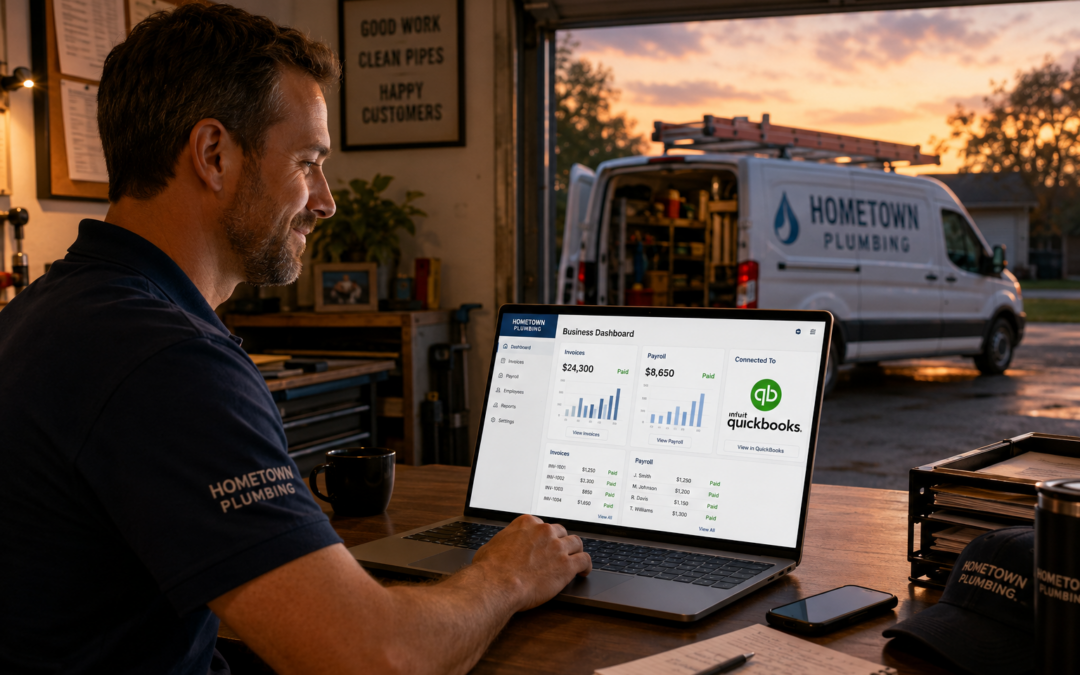
The Back Office Was Closed Again
A contractor I know runs a 22-person shop outside Kansas City. Mechanical work, some electrical, light commercial service. Good crews. Solid reputation.
Last month he called me, sounding fried.
“Carl, I was in the office until 11 p.m. on Sunday. Again. Chasing invoices, fixing a payroll mistake from Friday, and trying to figure out why our QuickBooks numbers do not match what PayPal says we collected.”
I asked him why he was doing all that himself.
“Because nobody else can. My office manager already does the work of three people. I am not hiring a fourth seat to chase paper. The margins do not work.”
That is the small contractor squeeze in 2026. Trucks rolling. Phones ringing. RFIs stacking up. And the owner is the one closing the books at midnight because hiring more office staff eats the profit on every job.
Anthropic just launched something that might actually move the needle on this. And they specifically named small trade contractors when they did it.
The Problem Nobody on the Truck Sees
The trades get judged by what happens in the field. Electrical service upgrades. Duct fabrication. Rooftop unit changeouts. Repipes. That is what your guys are out there doing every day.
But the business is not won or lost on the truck. It is won or lost in the office.
Here is what kills small construction companies:
- Invoices that go out late or never get sent
- Customers and GCs who do not pay and never get chased
- Payroll mistakes that cost you a good foreman
- Books that never get reconciled, so you do not know which jobs are actually making money
- Marketing that stops the second the owner gets busy
- Submittals and contracts sitting in someone's inbox for a week
Most shops under 50 employees are running this back office on one or two people, a stack of spreadsheets, QuickBooks, and a prayer. The owner fills the gaps at night.
Enterprise software companies have been selling AI to the giant general contractors for two years. The small and mid-size trade shops got nothing. Small businesses account for 44% of U.S. GDP and employ nearly half the private-sector workforce, but their adoption of AI has lagged way behind larger enterprises.
That gap is about to close.
The AI Shift: Claude for Small Business
On May 13, Anthropic launched Claude for Small Business. This is not another chatbot. This is the AI plugging directly into the tools you already use to run your company.
It is a toggle install that puts Claude to work inside Intuit QuickBooks, PayPal, HubSpot, Canva, Docusign, Google Workspace, and Microsoft 365. From there, it can plan payroll, close the month, run a sales campaign, chase invoices, and more.
Read that list again. QuickBooks. PayPal. Google Workspace. Microsoft 365. Docusign for contracts and change orders.
Those are the tools your office manager is already logged into all day.
Here is the part that should grab every contractor's attention. Anthropic's head of small business said the company built this because “small businesses have been underserved with AI.” When she gave examples of who this is for, she named “your 50-person HVAC company or your 25-person landscaping company.” Not law firms. Not tech startups. Trade shops.
This is the first time a major AI company has looked at a small trade business and said, “We built this for you.”
What This Looks Like Across the Trades
The product launched with 15 ready-made workflows. Invoice chasing. Payroll planning. Monthly close. Reconciliation. Marketing campaigns. New-hire onboarding. Here is how a few of those land in each trade.
Electrical. A service van wraps a panel upgrade Friday afternoon. The system sees the job marked complete in QuickBooks, pulls the labor hours and parts, and drafts the invoice. Your office manager approves it in 30 seconds. It goes out the same day instead of Tuesday.
Sheet Metal. A commercial fab shop closes the month. Normally that is three days of reconciling job costing against POs against vendor statements. The AI runs the first pass against QuickBooks and Microsoft 365, flags the discrepancies, and hands a 20-minute review back to the controller.
HVAC. A residential service company has a slow week. The AI spots the dip in QuickBooks revenue compared to the same week last year, drafts a tune-up campaign in Canva, and queues it up for the owner's approval before the email goes out through HubSpot.
Plumbing. A new tech gets hired. Instead of the owner spending two hours building the onboarding packet from scratch, the AI assembles the W-4, the handbook, the safety acknowledgments, and the Docusign envelope. The tech signs everything before he picks up his first work order.
One product. Four trades. Same problem solved.
What This Means for You
If you run a construction company, here is the straight answer.
The cost of running a small trade business has been climbing for ten years. Insurance up. Wages up. Trucks up. Materials up. Margins are not.
The only lever most contractors have left is operational efficiency in the office. And until now, the AI tools to actually pull that lever were built for companies with 500 employees and an IT department.
That changed Wednesday.
For project managers and foremen, this matters because the office finally has a way to keep up with the field. No more waiting three days for a submittal to get routed. No more wondering if the change order got signed.
For association executives, this is a turning point worth tracking. In a survey Anthropic ran, half of small business owners named data security as their biggest hesitation about AI. The product holds your existing permissions. If an employee cannot see something in QuickBooks or Drive today, they cannot see it through Claude. The security story is finally catching up with the contractor's reality.
And here is the controversial part. The trade contractors who ignore this for the next 18 months will be competing against shops that close their books in two hours instead of two days. That gap compounds. Fast.
Trying to run a 2026 construction company with 2018 office workflows is like towing a 30-foot trailer with the parking brake on. The shop still moves. It just burns fuel and brakes the whole way there.
Your Next Step
Practical actions for this week:
- List your three biggest office bottlenecks. Invoicing? Payroll? Reconciliation? Submittals? Marketing? You cannot fix what you have not named.
- Check what you already pay for. If you use QuickBooks, Google Workspace, or Microsoft 365, you are already in the ecosystem this tool plugs into. The lift is smaller than you think.
- Take the free training. Anthropic partnered with PayPal on a free online course called AI Fluency for Small Business, taught by owners who built AI into their own operations. Have your office manager finish it before the end of the month.
- Run one workflow as a test. Pick the invoice chase. Pick the monthly close. Pick one thing. Measure how many hours it saves over four weeks.
- Do not let the field lead the office on this. Your foremen are not going to drive this change. The owner has to. Block two hours on the calendar and make a decision.
Let's Build Your AI Roadmap
If your construction company is ready to stop running the back office on caffeine and overtime, let's talk. I help trade contractors figure out which AI tools fit the way their shops run, and which ones are just noise.
Book a consultation and we will map out a roadmap that works on real jobsites and in real offices. No BS… Just the workflow.
Current and Past Clients
- NECA Cascade - Mt. Vernon, WA - AI Workshops
- NECA SWW- Tacoma, WA - AI Workshops & AI Webinars
- NECA Seattle - Seattle, WA - AI Workshops
- NECA Portland, OR - AI Workshops
- NECA Oklahoma - OKC, OK - AI Workshops
- MCA Connecticut, Southington, CT, - AI Workshops
- SMACNA Connecticut, Granby, CT - OKC, OK - AI Workshops
- SMACNA Kansas - Wichita, KS - AI Workshops & AI Mastery
- MCA Ohio - Columbus, OH - AI Workshops
- NECA Chicago - Chicago, IL - AI Workshops
- NECA Milwaukee - Milwaukee, WI - AI Workshops
- PCA - Washington DC - AI Workshops
- MCA EMO - St. Louis, MO - AI Workshops & AI Webinars
- MCA Houston - Houston, TX - AI Workshops
- SMACNA National - Washington DC - AI Workshops
- MCA Greater Chicago - Chicago, IL - AI Workshops
- MCA NW Ohio - Northwood, OH - AI Webinars
- NERCA - Braintree, MA - AI Workshop
- NECA Illinois - Illinois, IL - AI Workshops
- PFEANE/GEANE - Boston MA - AI Workshops
- AGC Connecticut - Wethersfield, CT - AI Mastery
- BTEA - Braintree, MA - AI Workshops
- MCA Indiana - Indianapolis, IN - AI Workshops
- MCA Kansas City - Kansas City, MO - AI Workshops & AI Webinars