The Hidden Risks Contractors Must Address Before It's Too Late
The construction industry is rapidly adopting artificial intelligence tools to boost efficiency, streamline documentation, and improve safety protocols. From ChatGPT helping with incident reports to AI-powered transcription services capturing meeting notes, these technologies offer compelling benefits. However, contractors who fail to establish comprehensive AI policies are unknowingly exposing themselves and their clients to serious legal and financial risks.
When Good Intentions Lead to Costly Violations
Consider these real-world scenarios that are happening right now in construction companies across the country:
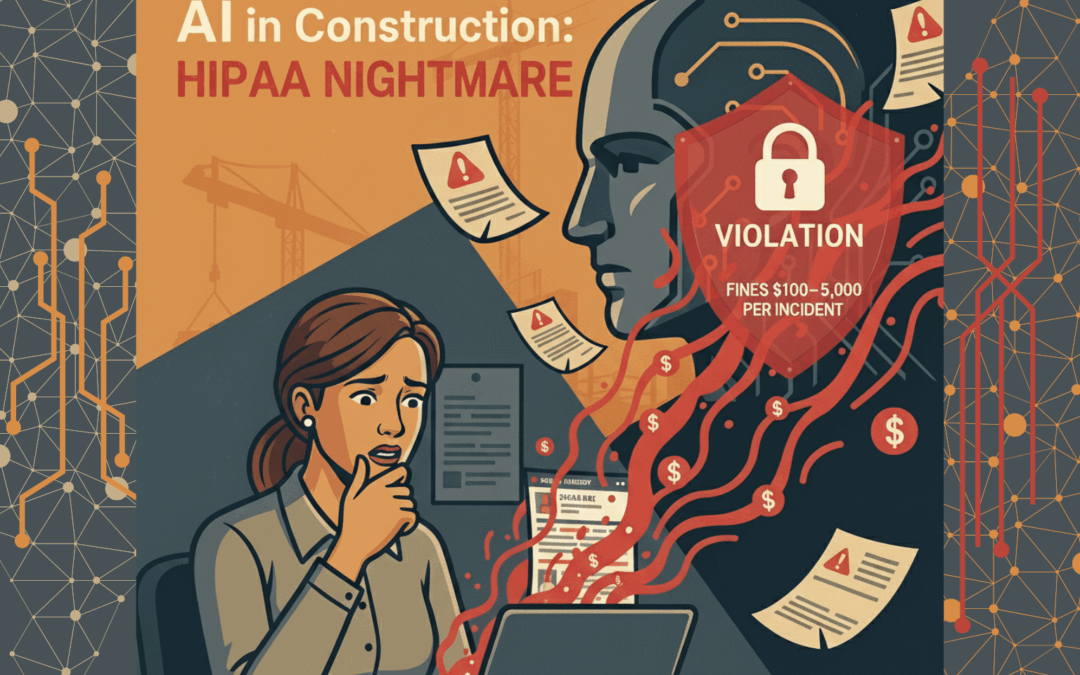
The HIPAA Nightmare
Sarah, an office manager at a mid-sized construction firm, needed to update an employee's file after he returned from rotator cuff surgery. Wanting to create a professional summary of his work restrictions, she copied his medical documentation into the free version of ChatGPT, asking it to "write a clear report about this employee's medical limitations for our HR file."
What Sarah didn't realize is that she had just violated HIPAA regulations. Free AI platforms often use input data to train their models, meaning sensitive medical information could potentially be stored, processed, or even accessed by unauthorized parties. The violation could result in fines ranging from $100 to $50,000 per incident, plus potential criminal charges.
The Defense Contract Disaster
Mike, a project superintendent working on a Department of Defense facility renovation, wanted to ensure his crew was following proper safety protocols. He used ChatGPT's image analysis feature to upload photos of the work area, asking the AI to identify potential OSHA violations.
This seemingly innocent safety check created multiple serious problems. First, photographing a DOD facility and uploading those images to a commercial AI platform likely violated the non-disclosure agreement and security protocols required for defense contracts. Second, it potentially compromised classified or sensitive government information. The consequences could include contract termination, legal action, and permanent blacklisting from government work.
The Privileged Information Problem
During a heated dispute with a subcontractor, project manager Jennifer used Otter.ai to record a conference call where the company's legal counsel was present discussing litigation strategy. The AI transcription service automatically processed and stored the attorney-client privileged conversation on external servers.
This action potentially waived attorney-client privilege, making the strategic legal discussions discoverable in court. The company's entire legal defense strategy could now be compromised, leading to significant financial exposure in the ongoing dispute.
The Financial Reality of AI Mistakes
These aren't hypothetical risks. Construction companies are already facing:
- HIPAA violations: Fines averaging $28,000 per incident, with some reaching millions
- Contract breaches: Loss of lucrative government contracts worth hundreds of thousands or millions of dollars
- Legal exposure: Compromised privileged communications can cost companies entire lawsuits
- Insurance issues: Professional liability carriers are beginning to exclude AI-related claims
- Reputation damage: Security breaches can destroy relationships with high-value clients
Building Your AI Protection Framework
Forward-thinking contractors are implementing comprehensive AI governance policies that protect both their business and their clients. Here's what your policy should include:
1. Data Classification and Handling Rules
Establish clear categories for different types of information:
- Public information: Company marketing materials, published safety statistics
- Internal information: Employee schedules, general project timelines
- Confidential information: Financial data, proprietary methods, client information
- Restricted information: Medical records, classified materials, privileged communications
Policy requirement: Employees must identify information classification before using any AI tool, with restricted information completely prohibited from AI platforms.
2. Approved AI Tools and Vendors
Not all AI platforms are created equal. Your policy should specify:
- Enterprise-grade tools: Platforms that offer business associate agreements (BAAs) for HIPAA compliance
- Zero-retention services: AI tools that don't store or use your data for training
- Security certifications: Vendors with SOC 2, ISO 27001, or equivalent security standards
- Government-approved platforms: For contractors working on federal projects
Example approved list: Microsoft Copilot for Business, Google Workspace AI with business agreements, AWS Bedrock with proper configurations.
3. Industry-Specific Restrictions
Different types of construction work require specific protections:
Healthcare construction: No patient information in any AI system; medical facility photos require special handling; HIPAA compliance mandatory for all documentation.
Government contracts: Complete prohibition on uploading photos, documents, or recordings from secure facilities; special approval required for any AI tool use on federal projects.
Corporate clients: Respect confidentiality agreements; obtain written approval before using AI on client-specific information; maintain separate protocols for each client's requirements.
4. Employee Training and Accountability
Your policy is only as strong as your team's understanding and compliance:
- Mandatory training: All employees must complete AI policy training before accessing company systems
- Regular updates: Quarterly briefings on new AI tools and emerging risks
- Clear consequences: Progressive discipline for policy violations, up to termination for serious breaches
- Incident reporting: Safe harbor for employees who accidentally violate policies but report immediately
5. Technical Safeguards and Monitoring
Implement systems to prevent and detect policy violations:
- Network filtering: Block access to unauthorized AI platforms on company devices
- Data loss prevention: Tools that detect when sensitive information is being uploaded to external services
- Regular audits: Monthly reviews of AI tool usage and data handling practices
- Backup procedures: Secure methods for tasks that previously relied on prohibited AI use
Taking Action: Your Next Steps
- Conduct an AI audit: Identify which employees are already using AI tools and for what purposes
- Assess your risk exposure: Review current contracts, insurance policies, and regulatory requirements
- Develop your policy: Work with legal counsel to create industry-specific AI governance rules
- Select approved tools: Research and implement enterprise-grade AI platforms with proper security controls
- Train your team: Ensure every employee understands the policy and their responsibilities
- Monitor and update: Regularly review and adjust your policies as AI technology evolves
The Bottom Line
AI tools offer tremendous potential for construction companies, but only when used responsibly. The contractors who will thrive in the AI era are those who recognize that powerful technology requires equally powerful governance. By implementing comprehensive AI policies now, you're not just protecting your business from costly mistakes – you're positioning yourself as a trusted partner who takes client protection seriously.
Don't wait for a violation to force your hand. The time to act is now, before a well-intentioned employee's AI use becomes your company's biggest liability.