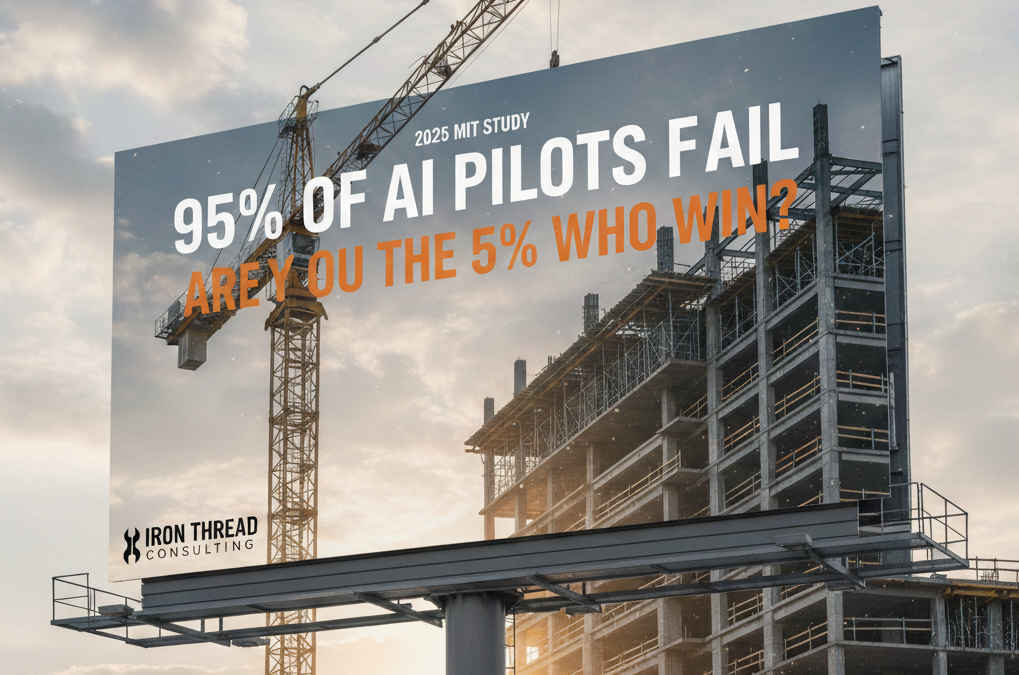
Here's a stat that should stop every contractor in their tracks: a 2025 MIT study found that 95 percent of enterprise AI pilot programs fail to deliver measurable financial returns.
Ninety-five percent.
At the same time, the companies that get AI right are seeing returns of 300 percent or more. Productivity gains of 25 to 50 percent. Time savings that let them bid more work with the same headcount.
So what separates the 5 percent who win from the 95 percent who waste their money?
After delivering AI workshops to construction trade associations across the country, I've seen both sides of this equation. The answer isn't about the technology. It's about how you train your people to use it.
The Fundamental Mistake
Most companies approach AI backwards.
They start by buying software. They hand it to their team with minimal guidance. They expect magic to happen. And when nothing changes, they conclude that "AI doesn't work for construction."
The problem isn't the AI. The problem is assuming a tool can transform your business without anyone learning how to use it.
Imagine handing a new apprentice a complete set of power tools on day one and expecting finished work. You'd never do that. Tools require training. Skills require practice. Workflows require development.
AI is no different.
What Actually Works
The organizations achieving strong AI ROI share five characteristics. None of them are about spending more money on software.
They start with specific problems, not general curiosity.
The contractors getting results aren't asking "what can AI do?" They're asking "how do I get RFI responses out faster?" or "how do I stop spending three hours on every bid comparison?"
Specificity matters. Anthropic's research shows that AI productivity gains vary wildly by task. Compiling information from reports shows approximately 95 percent time savings. Checking diagnostic images shows only 20 percent. The difference isn't the AI. It's whether the task matches what AI does well.
When you train people on specific applications for their specific roles, they immediately see value. When you give them generic AI training, they immediately forget it.
They measure before and after.
You can't improve what you don't measure.
Before any AI implementation, document how long tasks actually take. How many hours does your estimator spend on bid analysis? How long does it take to draft a project update email? How much time goes into reviewing submittals?
Then measure again after training. The ROI calculation becomes straightforward: hours saved multiplied by hourly cost equals dollar value.
Industry benchmarks suggest targeting a minimum 25 percent productivity improvement on AI-assisted tasks. High performers achieve 40 to 50 percent gains. If you're not measuring, you have no idea whether you're succeeding.
They train the whole team, not just the tech-savvy.
A BCG study revealed something surprising: even participants with moderate coding experience outperformed novices on AI-augmented tasks, even when coding wasn't required.
Context and experience amplify AI effectiveness.
Your project manager with 15 years of experience will get more value from AI than a new hire because they know what questions to ask. They understand which corners the AI might cut. They can spot when something doesn't match how your company actually operates.
That experience becomes more valuable with AI, not less. But only if those experienced people receive proper training.
The companies that train only their youngest employees miss the point entirely. The combination of construction expertise plus AI capability is the winning formula.
They redesign processes around AI, not just add AI to existing processes.
Here's where most companies fail.
They take a process that takes an hour, add AI somewhere in the middle, and save five minutes. Then they declare AI a disappointment.
The winners redesign from scratch. Instead of having an estimator manually gather historical data, then use AI to analyze it, then manually write up findings, they ask: what if AI handled the entire workflow?
One example from the legal industry shows a firm reducing complaint response drafting from 16 hours to 4 minutes by completely reimagining the process. The same principle applies to construction. A bid narrative that takes hours can become a fifteen-minute task, but only if you're willing to rebuild the process around what AI makes possible.
They treat training as ongoing, not one-time.
AI capabilities change monthly. New models release. New features appear. New applications become possible.
The companies succeeding with AI treat learning as continuous. They create space for experimentation. They share what works across teams. They bring in outside expertise to keep skills current.
A single training session might create initial momentum, but sustained advantage requires sustained learning.
The Cost of Getting It Wrong
When AI initiatives fail, the damage goes beyond wasted software subscriptions.
Your team becomes skeptical. "We tried that AI thing and it didn't work" becomes the default response to any future technology discussion. Change resistance hardens into institutional cynicism.
Meanwhile, your competitors who got it right pull further ahead. They're bidding work faster. They're managing projects with less overhead. They're winning the talent competition because skilled workers want to be at companies that embrace tools that make work easier.
The gap compounds. Every month you spend recovering from a failed AI pilot is a month your successful competitors use to extend their lead.
The Training Investment That Pays
Proper AI training costs money. Good workshops aren't cheap. Neither is the time your team spends away from billable work.
But consider the alternative math.
If AI training helps your estimating team save five hours per week, and you have three estimators with a loaded cost of $75 per hour, that's $58,500 per year in productivity gains. For one department.
If your project managers can handle 10 percent more projects without adding headcount, what's that worth?
If your superintendents spend 30 minutes less per day on documentation and reporting, what could they accomplish with that recovered time?
The companies achieving 300 percent ROI on AI aren't getting there through software purchases alone. They're getting there through training that translates AI capability into construction application.
What Your Competition Already Knows
The Dodge Construction Network survey found that 40 percent of firms have already created dedicated AI budgets. More than half are piloting tools or upskilling teams right now.
This isn't future talk. This is happening today.
The contractors you bid against are evaluating how AI changes their cost structure. They're training their people. They're finding efficiencies you haven't discovered yet.
Every week you delay, they get better.
The construction industry has historically been a technology laggard. Companies that waited to adopt BIM spent years catching up. Companies that resisted digital plan management eventually had no choice but to convert.
AI adoption is following the same curve, just faster. The window to be an early adopter is closing.
How to Start Right
If you want to be in the 5 percent who succeed with AI, here's the path:
Pick one department or one function to start. Not the whole company. Not a vague "AI initiative." One team with one set of problems.
Identify three to five specific tasks where AI could help. Be concrete. "Estimating" is too vague. "Comparing subcontractor bids against historical pricing" is specific enough to train around.
Get proper training. Not YouTube tutorials. Not "figure it out" experimentation. Structured training that connects AI tools to construction workflows.
Measure everything. Time before, time after. Quality before, quality after. Make the ROI undeniable.
Share what works. When your estimating team succeeds, let your project management team learn from their experience. Build internal momentum.
Keep learning. Schedule refresher training. Create channels for sharing new applications. Treat AI competency as an evolving capability, not a checkbox.
The Bottom Line
The 95 percent failure rate isn't a technology problem. It's a training problem.
The companies that invest in proper AI education for their construction teams succeed. The companies that expect technology to magically transform their operations fail.
You already know how this works. You'd never hand a new piece of equipment to your crew without training. You'd never expect an apprentice to perform like a journeyman on day one. You'd never assume that buying better tools automatically means better work.
AI is exactly the same.
The only question is whether you want to be in the 95 percent who waste their investment or the 5 percent who transform their business.
--
Carl Britton Jr. is the founder of Iron Thread Consulting and delivers AI workshops for construction trade associations including NECA, SMACNA, and MCA chapters nationwide. With 20 years in construction and 15 years in technology, he speaks construction, not tech. Learn more at ironthread.online.
Current and Past Clients
- NECA Cascade - Mt. Vernon, WA - AI Workshops
- NECA SWW- Tacoma, WA - AI Workshops & AI Webinars
- NECA Seattle - Seattle, WA - AI Workshops
- NECA Portland, OR - AI Workshops
- NECA Oklahoma - OKC, OK - AI Workshops
- MCA Connecticut, Southington, CT, - AI Workshops
- SMACNA Connecticut, Granby, CT - OKC, OK - AI Workshops
- SMACNA Kansas - Wichita, KS - AI Workshops & AI Mastery
- MCA Ohio - Columbus, OH - AI Workshops
- NECA Chicago - Chicago, IL - AI Workshops
- NECA Milwaukee - Milwaukee, WI - AI Workshops
- PCA - Washington DC - AI Workshops
- MCA EMO - St. Louis, MO - AI Workshops & AI Webinars
- MCA Houston - Houston, TX - AI Workshops
- SMACNA National - Washington DC - AI Workshops
- MCA Greater Chicago - Chicago, IL - AI Workshops
- MCA NW Ohio - Northwood, OH - AI Webinars
- NERCA - Braintree, MA - AI Workshop
- NECA Illinois - Illinois, IL - AI Workshops
- PFEANE/GEANE - Boston MA - AI Workshops
- AGC Connecticut - Wethersfield, CT - AI Mastery
- BTEA - Braintree, MA - AI Workshops
- MCA Indiana - Indianapolis, IN - AI Workshops
- MCA Kansas City - Kansas City, MO - AI Workshops & AI Webinars