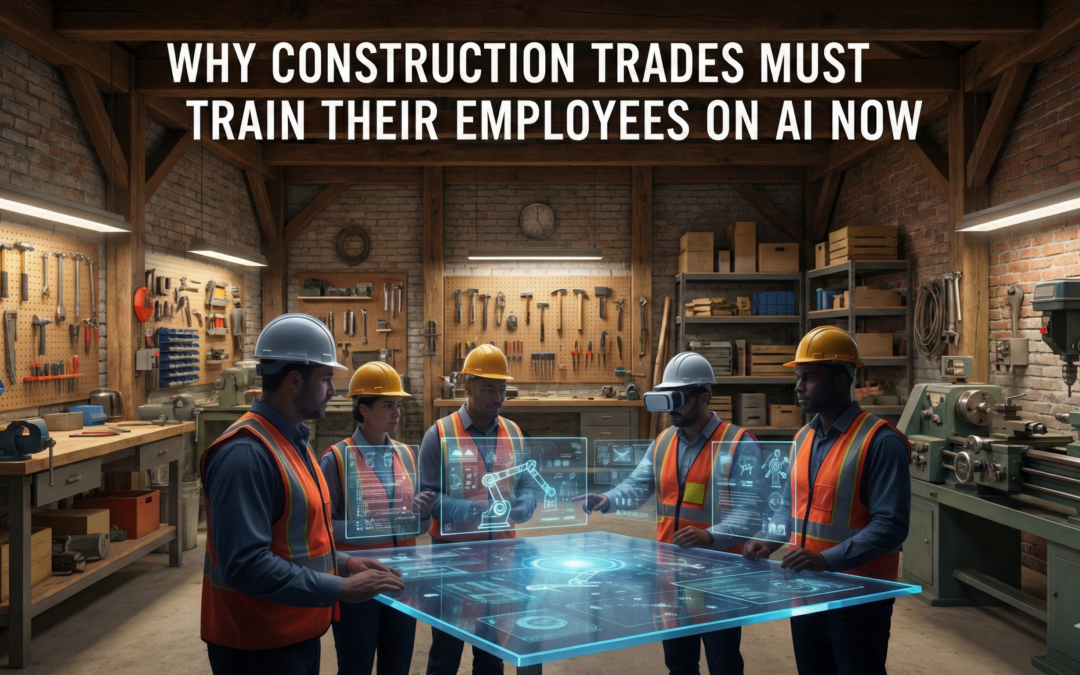
The construction industry sits at a critical crossroads. While AI tools have become part of everyday life, most construction companies haven't made formal AI training part of their workforce development plans. That needs to change.
Here's the reality: your competitors are already experimenting with AI, your younger workers expect these tools, and the efficiency gaps are growing wider by the month. The question isn't whether to train your people on AI, but how quickly you can get started.
1. The Labor Shortage Demands Better Productivity
The construction industry faces a well-documented workforce crisis. According to Associated Builders and Contractors, the industry needs to attract an estimated 546,000 additional workers in 2026 on top of normal hiring pace to meet demand. Meanwhile, the average age of construction workers continues to climb.
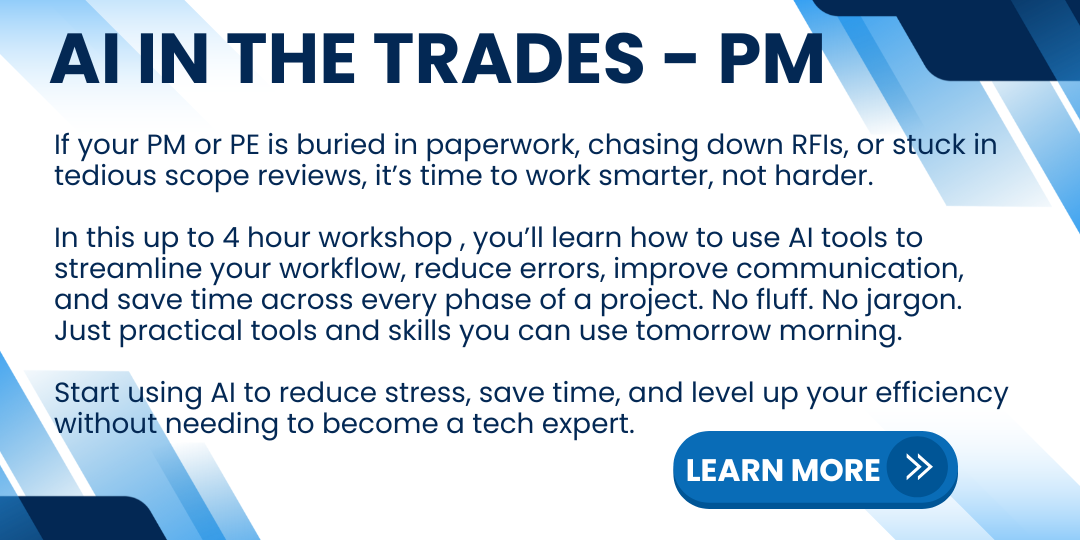
You can't hire your way out of this problem fast enough. AI training offers a different solution: making your current workforce significantly more productive. When a project manager uses AI to draft submittals, analyze RFIs, or create preliminary schedules, they complete in 20 minutes what previously took three hours. That's not just efficiency. That's the equivalent of adding capacity without adding headcount.
The trades that embrace AI training will stretch their existing teams further while competitors continue struggling to fill positions. This isn't about replacing workers. It's about multiplying what each person can accomplish.
2. Younger Workers Already Expect These Tools
Generation Z and younger millennials have grown up with AI-powered tools in their pockets. They use ChatGPT to research purchases, plan trips, and solve problems. When they join your company and discover they can't use these same tools at work, you create an immediate disconnect.
A 2023 Microsoft Work Trend Index found that 70% of workers would delegate as much work as possible to AI to lessen their workloads. Your incoming workforce isn't afraid of AI. They're confused about why you aren't using it.
By providing formal AI training, you send a clear message: your company invests in modern tools and skills development. This matters for retention. It matters for recruitment. The best young talent will gravitate toward companies that equip them with cutting-edge capabilities, not those clinging to outdated methods.
3. AI Reduces the Administrative Burden That Kills Profitability
Every contractor knows the frustration: the actual construction work is profitable, but the paperwork eats away at margins. Safety reports, daily logs, meeting minutes, email responses, proposal writing, change order documentation. These tasks are necessary but they don't directly generate revenue.
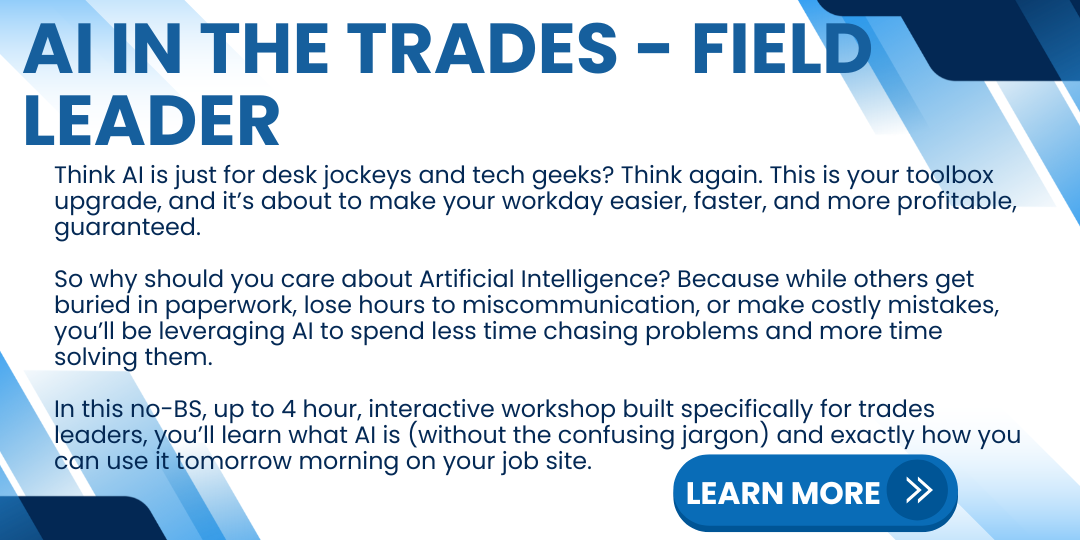
AI excels at exactly these administrative tasks. A superintendent can photograph a daily progress report handwritten in the field and have AI convert it into a properly formatted document in seconds. A safety manager can use AI to draft toolbox talks customized for specific tasks. An estimator can have AI analyze specifications and pull out key requirements that might otherwise be missed.
Companies that train their teams on these applications report dramatic time savings. What used to require an administrative assistant and two hours now takes the field person 10 minutes. The work quality often improves too, because AI can maintain consistency and catch details that humans miss when rushing through paperwork at the end of a long day.
4. Risk Management and Quality Control Get Stronger
Construction projects involve massive complexity and countless opportunities for costly mistakes. AI training helps your team catch problems before they become expensive failures.
Consider specification review. A project manager can feed an AI tool the project specs and ask it to identify potential conflicts, ambiguous language, or requirements that differ from standard practice. The AI won't catch everything, but it will flag issues a human reviewer might miss, especially on page 487 of a 600-page specification package.
The same applies to safety planning. AI can analyze a work plan and suggest potential hazards based on similar projects. It can review incident reports and identify patterns humans might overlook. It can help ensure your job hazard analyses cover scenarios you haven't personally encountered.
None of this replaces human judgment. But it augments it. A well-trained team using AI as a second set of eyes will identify and mitigate more risks than a team relying solely on human review, no matter how experienced.
5. The Competitive Gap Is Already Opening
Here's the uncomfortable truth: some of your competitors have already started training their people on AI. They're moving faster on estimates. They're responding to RFPs more thoroughly. They're completing administrative tasks in a fraction of the time.
This creates a compounding advantage. The company that can produce a detailed estimate in two days while you need a week wins more bids. The company that can manage more projects with the same PM team can take on more work. The company that documents everything flawlessly has fewer disputes and better relationships with clients.
The gap will only widen. Early adopters are learning what works, refining their processes, and building AI capabilities into their standard operating procedures. Companies that wait will find themselves playing catch-up, trying to implement in months what others perfected over years.
The Path Forward
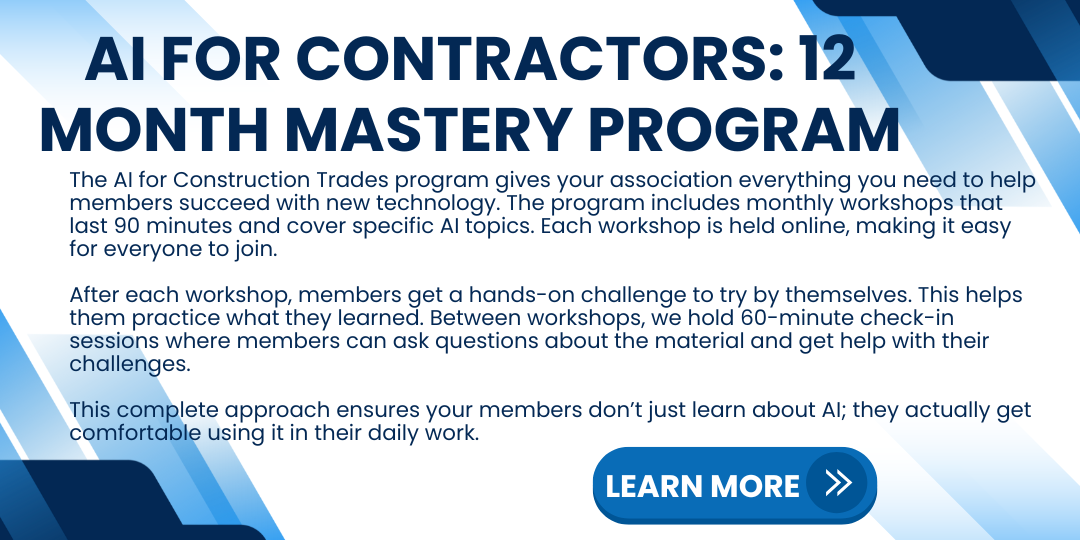
Training your workforce on AI doesn't require a massive technology overhaul or six-figure consulting contracts. It starts with education. Help your team understand what AI can and can't do. Show them practical applications specific to their roles. Give them permission to experiment within appropriate boundaries.
The construction trades built America's infrastructure through skilled labor and continuous improvement. AI is simply the next evolution of that tradition: better tools that let skilled people do more sophisticated work more efficiently. A few NECA, SMANCA, AGC, ABC, and MCA Chapters have started offering training for their contractors but there is room for significant improvement on Contractor Associations offering more.
The companies that recognize this and invest in training now will define the next decade of the industry. Those that don't will spend that decade wondering why they can't compete.
Your move.